Deaf and...
Tabitha Jacques
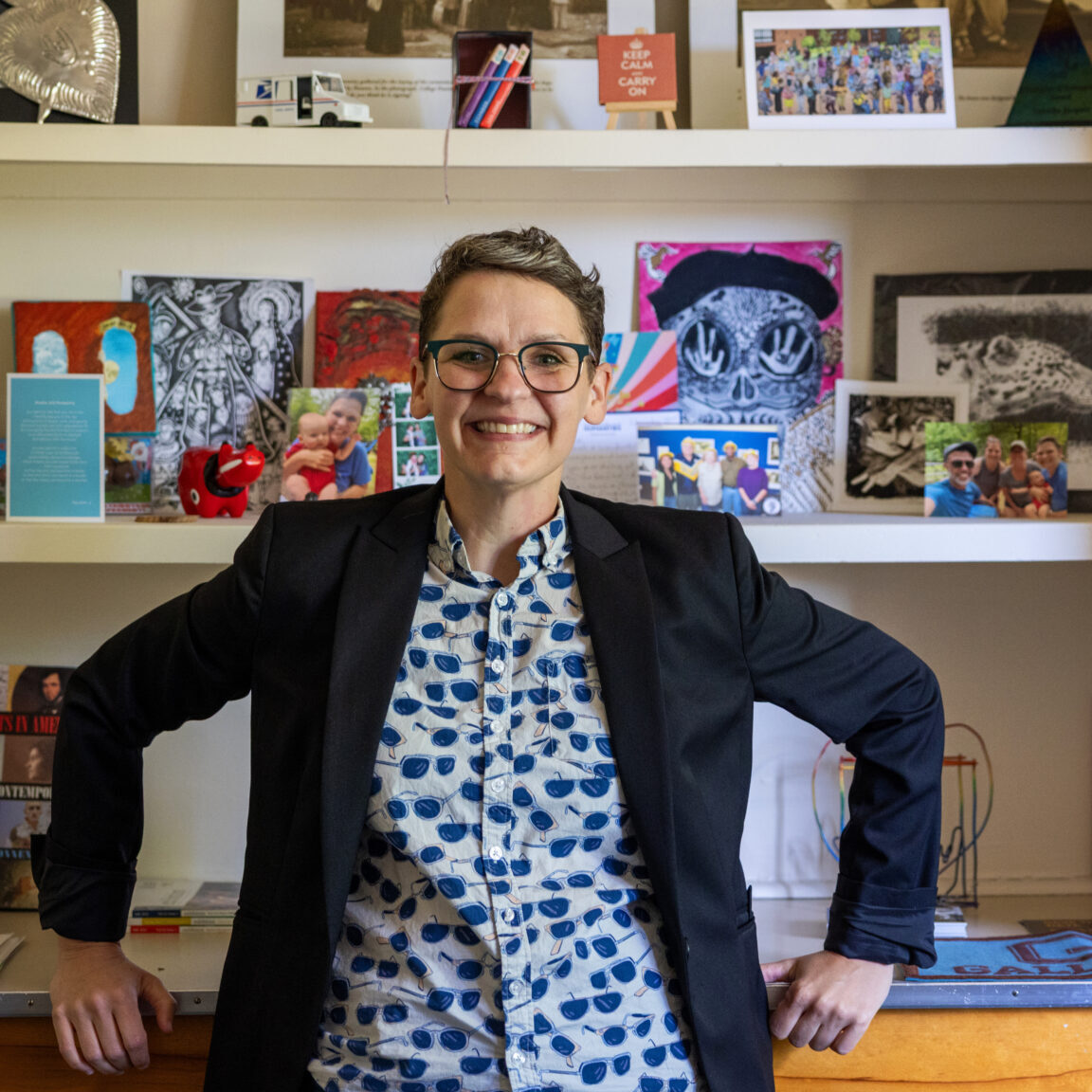
Image Description
Photograph of Tabitha Jacques, a white woman with short brown hair and round glasses, wearing a dark blue blazer with a blue-white patterned button-up shirt. She is leaning on a wooden desk with many colorful books on shelves behind her. (Charles Eppley)
While the history of formal deaf art is relatively short (spanning approximately fifty years), it has been dominated by white deaf artists. Art made by deaf people has existed for hundreds of years, but it was not until the 1970s that deaf artists intentionally created art to portray the self, specifically focusing on the deaf experience. This led to the establishment of Deaf View Image Art (De’VIA) movement in 1989. Since then, deaf, white, mostly straight (several of the founders of De’VIA are openly gay or lesbian), cisgender, and able-bodied artists’ works have been showcased in public spaces or taught in educational settings. This focus has meant that many of the layered complexities that comprise the deaf community are left out of the popular conception of deaf art.
It was not until the rise of social media that BIPOC, LGBTQ, DeafBlind, and/or DeafDisabled artists came into general consciousness. They had been around and had been creating works reflecting their experiences prior to social media, but the works were not seen by others. These artists are now much more recognized and revered within the deaf community, but not as much outside that sphere as able-bodied artists and their stories. De’VIA artwork typically includes motifs of hands, eyes, ears, and mouth, among others. The face, eyes and the hands are usually magnified, emphasizing the importance of those body parts for communicating in a two-dimensional way.
However, when reviewing this gallery of non-De’VIA works, you will see that the figure of the body often takes precedence over the face, which is likely to be represented in abstract figures or not included at all, as seen in the works of Sean-Michael Gettys, Jaimeson Pleasants, and Selene Alvarez. Hands are used for the purpose of a tactile experience of understanding and communicating with the world such as in the case of DeafBlind poets John Lee Clark and Rossana Reis.
De’VIA works typically include representations of Deaf history through a white person’s lens. Takiyah Harris is the first Black Deaf artist to create works that tell Black Deaf stories which have been left out of the canon of Deaf history.
Through this gallery, I invite you to consider the complexities and the depths of the deaf community. In addition to the deaf community’s many preferences in language modality and hearing identities, there are also gender, cultural, sexual, racial identities and disabilities that shape a deaf person’s experience in the world. While the common thread is that all the artists are deaf, not all of them may consider their deafness as what defines them.
About the Artists
John Lee Clark
John Lee Clark is an American deafblind poet, writer, and activist from Minnesota. He is the author of Suddenly Slow (2008) and Where I Stand: On the Signing Community and My DeafBlind Experience (2014), and the editor of anthologies Deaf American Poetry (2009) and Deaf Lit Extravaganza (2013). Clark was the recipient of a 2020 National Magazine Award. He is a prominent activist in the Protactile movement.
Rossana Reis
I am a Brazilian Panqueer DeafBlind Disabled Neurodivergent artist, poet and writer. My mosaic artworks continue to evolve as I soulfully embrace the creative expressions and mysteries. I often write about multiple truths and realities of being, being marginalized within marginalized communities, and the ways in which one may be liberated.
Takiyah Harris
I was raised in Kankakee, Illinois and came from a hearing Black family. My family shared stories about our migration from the South. I am a fine art photographer who captures color and black & white photographs from the environment and other events. I am also a haptic artist using collage to explore Deaf culture with a focus on Black Deaf experiences.
Sean-Michael Gettys
Sean-Michael Gettys is a Hard-of-Hearing (HoH)/disAbled, Queer/Pansexual, Transgender (FtM) artist working in non-acrylic mixed media. He lives with a complex set of medical diagnoses and congenital oddities, which impact his life in different ways that include periodic changes to his hearing, severe allergic reactions to many things that necessitates the frequent use of a respirator mask, and others that lead him to use mobility aids like a wheelchair or, for short trips in non-crowded areas, a walker.
Selene Alvarez
Selene Alvarez is a Fat, Deaf, Queer, & Latinx Multi-Dimensional artist. Primarily an acrylic painter whose passions thrive when creating vivid art for the soul through body and nature appreciation. Creating vivid and luscious art in various mediums allows them to claim space as a fat queer femme and nourish their mental health.
Jaimeson Pleasants
Lorem ipsum dolor sit amet, consectetur adipiscing elit, sed do eiusmod tempor incididunt ut labore et dolore magna aliqua. Ut enim ad minim veniam, quis nostrud exercitation ullamco laboris nisi ut aliquip ex ea commodo consequat. Duis aute irure dolor in reprehenderit in voluptate velit esse cillum dolore eu fugiat nulla pariatur. Excepteur sint occaecat cupidatat non proident, sunt in culpa qui officia deserunt mollit anim id est laborum.